
As one of the strong, opinionated women of the unpleasant Noughties taken down by the press as soon as they’d had a sniff of success, Lily Allen is now enjoying the pre-eminence she deserved back then – or so the current feeling goes. A child of the phone-hacking era, she has made the record of her career in the same vernacular: its powerful realism lies in lyrics crafted from the texts of her now ex-husband, David Harbour, while her famous “receipts dress” – a huge Lycra sheet printed with the bills of gifts for his mistress – was her own expenses scandal.
While she has admitted to some poetic licence with the record, West End Girl has been pitched and received as a revenge saga, and the extraordinary crowd at her London Palladium gig are full of righteous justice. I can’t remember a show where the audience has been such a strong presence. They sing in one voice – a voice just like hers – and the velvet seats shake with that weird kind of dancing people do when they can’t quite face standing up. They look each other in the eyes, and jab their fingers at the empty stage, crying “It’s hard for a bitch” down a wormhole of irony that Allen understands so well. I don’t know the reasons behind the controversial decision to do an entire set of karaoke “hits” with a string trio for the first half, without Allen being on stage, but one powerful effect of that is to showcase the tribe that supports her.
Many of them reactivated their interest via Miss Me?, Allen’s podcast with Miquita Oliver, the childhood friend (and daughter of BBC presenter Andi Oliver) with whom she grew up, sleeping among a pile of kids in a back room in West London while the parents partied. A TV personality in her own right, Miquita was destroyed by the press; the podcast was a chance for two women with little to lose to talk about stuff we had already seen through the media gaze, telling their side of the story at last. Then the conversation began to change, as things changed in Allen’s private life. Talk went back, often, to physical appearance: I needed a facelift (never wanted), I needed to lose weight, she said of her past selves. Allen was trashed for her West End acting debut (2:22 – A Ghost Story) the same week that she discovered Harbour was cheating on her. The internal pressure she felt to seek physical approval online was intense, but with characteristic ambiguity she has said that not only did the approval feel good when it came, but that she knew this was a problem for her mental health. There isn’t anything anyone can criticise her for that she hasn’t already. It is out of touch to think of her as a “role model” for her crowd; to assume she has responsibility to be anything, or to handle her success in any particular way, is part of the problem of being a famous woman.
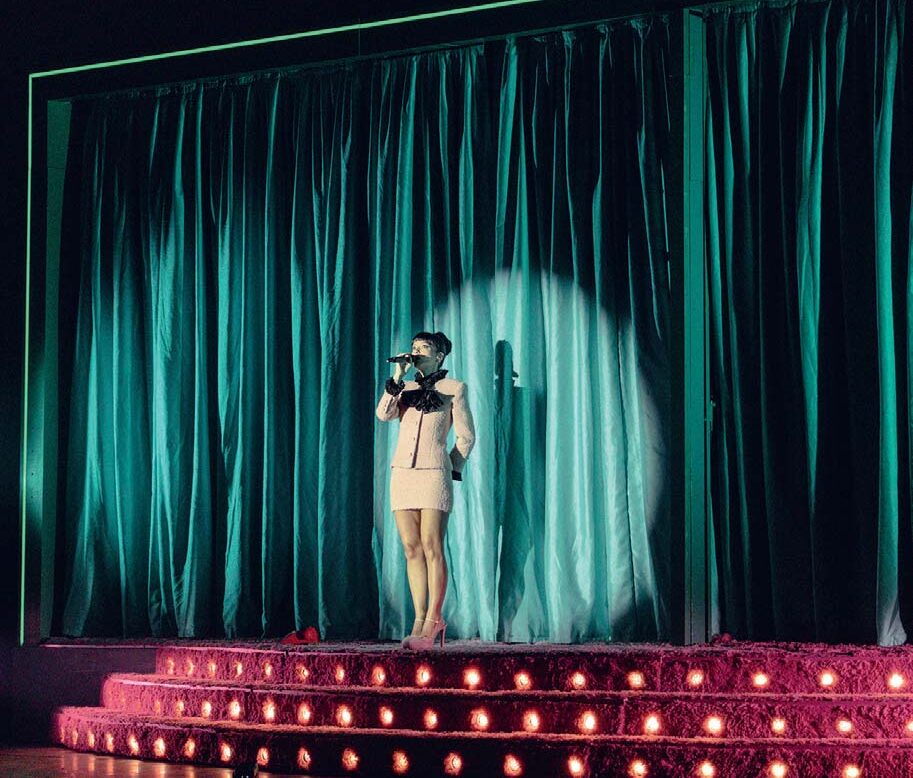
Still, there is something uneasy about West End Girl as it lives on the stage. The album’s strength is its naturalism; it is really an achievement of language, of ordinary speech. The theatre set is, by contrast, innately stylised (she performs in a green and pink bedroom of Fifties Hollywood technicolour). So a line like “It was how you grabbed your phone back right out of my hands” (from “Tennis”) – so full of modern-day chills – is delivered by a figure on stage consumed not by neurotic horror, but picking her way carefully up the steps in stilettos and a nightie trimmed with pom-poms: an Edward Hopper woman, insulated from feeling. Allen, that shrugging symbol of realistic womanhood, is as brittle and airbrushed here as she is on Instagram.

What I missed most was contact with the audience – chat, banter – from someone so naturally funny. As I’ve said, this was no ordinary crowd: there was certainly no fourth wall in Allen’s “theatre”, and the karaoke made it more interactive than a pop concert. How odd to have that level of interaction, but to keep it one-way, save for a couple of smiles and a sweet, deliberately clumsy curtsey. I wondered if she was replicating the experience of living online. She stalked slowly back and forth, losing items of clothing along the way. Realism and pain, delivered with poise and economy; a warts-and-all record with no visible warts. The sense of real and unreal that is Lily Allen.
In soft-plays and in swimming pools over the last few years I have discussed Allen with a friend who loved the podcast, then stopped listening, partly because of the way Allen and Oliver talked about physical image. She now feels weird about the whole thing. “It’s like she’s pushing herself to ride this wave and it’s uncomfortable,” she told me. We found ourselves speculating about how Allen is “coping” – something you’d never wonder about Taylor Swift, say, after a break-up album. We imagined that to hit the critical high-point of your career, off the back of the collapse of your marriage and bad reviews, would be, to put it bluntly, a colossal headfuck – it would make you feel that people only wanted to see you suffer, all over again; it would make you believe that was the way to sell records. I even wondered whether, faced with a world tour of giant arena dates for the first time in her career, it suddenly made sense to cut the show in half and make the first part karaoke with a string trio, just to take the pressure off.
All these ruminations assume Allen is as vulnerable as she seems – when perhaps that vulnerability is her art, summed up in a brilliant song like “Dallas Major” when she imagines her internet dating profile (“I’m almost nearly 40, I’m just shy of five-foot-two/I’m a mum to teenage children, does that sound like fun to you?”). She vividly paints a picture of people who throw themselves at the feet of a cheating partner, promising to change – and we have all fawned desperately in the presence of a wrong ’un: it’s only in American pop videos that we chop them up and put them in the trunk of a car. Perhaps Allen is interested in showing the truth of human nature – so biological, so hard-wired – as it lies constant beneath all our recent cultural revolutions. That might be empowerment in its own way. But I’m not sure.
I like that she is reclaiming the West End after her lukewarm theatre reviews – a stylish touch. It’s amusing that she has refocused attention on The Album – that supposedly obsolete form – by performing her own one, cover to cover, and refusing to play her old hits. You can sing them by yourself if you want. At the end, someone comes on and presents a bouquet to her, as if she’s a Hollywood star. But she has not given of herself on stage, the way a Hollywood star used to do – maybe because she has given too much of herself already.
I didn’t feel particularly short-changed by the running time of her set. The interval was long enough for me to have not one but two wees, and there was a scene change (men in black moving lampshades around) that lasted longer than it needed to. I realised this might be a clever way of pushing Allen’s set up by a few minutes, because we were promised an hour, and West End Girl is only 44 minutes and 59 seconds long. She just about managed it, and walked off the stage at 9.59pm.
Lily Allen West End Girl Live
20 March
The London Palladium, London W1
Lily Allen is on tour across the UK until 7 July
[Further reading: We must love WH Auden or die]
Content from our partners



Related



This article appears in the 25 Mar 2026 issue of the New Statesman, Easter Special
Join the debate
Subscribe here to comment